
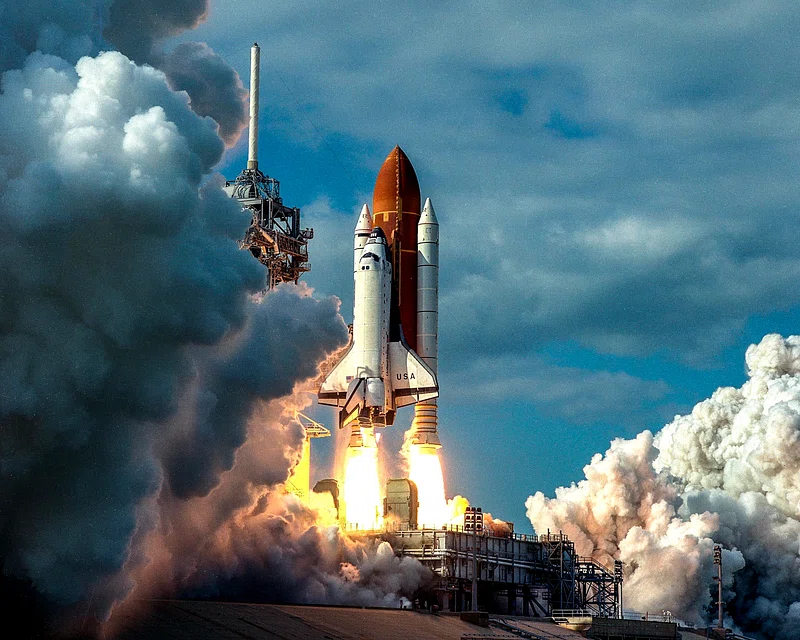

I remember the exact moment that my space exploration ‘spark’ ignited: I was 7-years-old and glued to the television watching the first crew liftoff on the Space Shuttle Columbia.
I didn’t have the vocabulary at the time to express what instantly drew me in, but I knew that it wasn’t as simple as wanting to be an astronaut or an engineer. Space exploration is one of the loftiest of human endeavors, and it has always carried an inherently cooperative spirit. It calls on nations, cross-disciplinary teams and individuals alike to set aside their differences in pursuit of something none of us can achieve alone. Technically and philosophically, it unifies.
While that broad spirit is what first captured me, my intellectual and personal passions reached peak alignment when I stumbled upon the interdisciplinary field of technology development where I discovered I could live at the intersection of science, engineering, and the human experience.
What intrigues me is that if you ask people what scenarios come foremost to mind when they imagine life aboard the International Space Station (ISS), they inevitably conjure images of sterile, stainless-steel hardware and complex science experiments.
What they don’t often mention is:
Communication, such as astronaut reading an email from her family, or the quiet sense of communion in sharing a rehydrated meal as a crew, or, the remarkable engineering feat that is going to the bathroom in microgravity!
Yet it is THESE moments that matter most to the people LIVING there — because they are human first and astronauts second. Technology in space doesn’t just keep the lights on, it delivers the things that keep human beings human; productive, healthy, dignified, and connected to each other and to those who care for them back on Earth.
The most achingly ordinary moments of life are recreated 250 miles above it. That’s not just engineering, it’s connection and empathy realized through exploration and hardware. The most impactful technologies ever developed, in space and on Earth, are the ones built in that spirit.
That conviction was recently reinforced when I had the privilege of serving as a Technical Advisor on the film adaptation of Project Hail Mary. What struck me most was how naturally the conversations with the production team flowed between the highly technical aspects of space systems and the deeply human stories behind the people who use them.
That feeling was strikingly reminiscent of what I felt watching Columbia, and I believe it’s the same reason the film resonated broadly enough with worldwide audiences to become a $500M blockbuster. The story captures something almost primal about why we go to space in the first place. We don’t go just because we’re curious. We explore because it ultimately makes us more human. It offers a powerful perspective on our Earthly home and our collective place on it.
The tangible benefits of this pursuit have been exponentially validated at a global scale through the unprecedented volume of shared scientific data and engineering achievements produced by the 25-plus year cooperative nature of the ISS platform, which is made all the more remarkable by the fact that it required an equally unprecedented level of sustained technical, policy, and genuinely human-to-human cooperation across dozens of long-term, multicultural partnerships. That is no small feat.
The importance of that cooperative function grows even more urgent as we navigate a commercial low-Earth orbit economy at a genuine tipping point while permanent deep space human exploration simultaneously moves from aspiration to operational reality.
The need for a unified, proactive methodology that integrates human systems science, technology, and policy across the U.S. government, industry, and an ever-growing community of spacefaring nations has never been greater.
It is not a coincidence that the same spirit that inspired 7-year-old me has remained the fundamental motivator across my nearly 30-year career with NASA and through founding MAVE[N] Innovations. It is precisely why I’m genuinely excited to join forces with the extraordinary team at SolaMed Solutions as Chief Technologist – uniting purpose and passion with more than 300 years of combined experience in making human health and the human experience a priority AND a practice in the policy and operations of spaceflight.
This imperative cannot be an afterthought or perceived as a “soft” concern alongside the “real” technical work, it is the real work.